
Shopping Cart


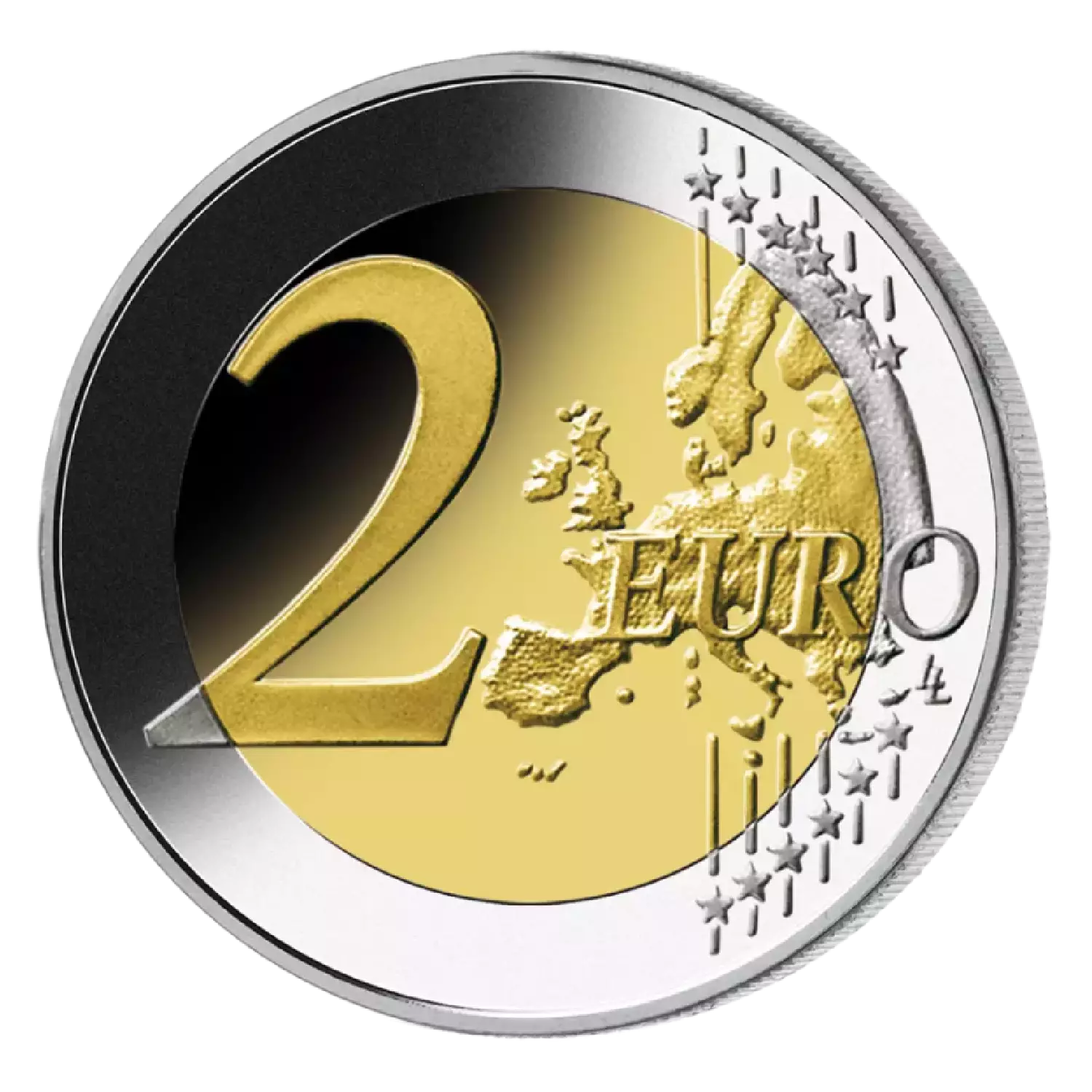
A 2 euro commemorative coin of the Hellenic Republic, issued in 2023 with a circulation of 740,500 copies. Dedicated to the 150th anniversary of the birth of Constantine Carathéodory. The author of the design is Georgios Stamatopoulos. Bimetallic, diameter 25.75 mm, weight 8.5 g.
Overse
The center of the coin depicts a portrait of Constantine Carathéodory, one of the most prominent Greek mathematicians of the 20th century. Next to the portrait is his famous mathematical symbolism - variants of formulas from real analysis and measure theory. Around the circle in Greek: "KONSTANTINOS KARATHEODORI" and the years "1873-2023", as well as "ΕΛΛΗΝΙΚΗ ΔΗΜΟΚΡΑΤΙΑ". The mark of the Athens Mint is an anthemion. The author's monogram "ΣΤΑΜ". On the outer ring are the 12 stars of the European Union.
Reverse
The reverse is the common side of the 2 euro coins of the second type, designed by Luc Luix. It depicts a map of Europe as a single continent without internal borders. On the left is a large denomination "2" and the inscription "EURO", on the right is a map. On the outer ring are the 12 stars of the EU.
Historical context
Constantin Carathéodory (Κωνσταντίνος Καραθεοδωρή, 1873-1950) is one of the most prominent Greek mathematicians of the 20th century, a representative of the highest level of world mathematics. He was born on September 13, 1873 in Berlin to a Greek family from Constantinople. He received an engineering education in Belgium, later switched to pure mathematics in Göttingen, where he defended his doctorate under the supervision of Hermann Minkowski (1904). He worked as a professor in Hanover, Wrocław, Göttingen, Berlin, Smyrna (1920-1922, first rector of the Ionian University), and finally in Munich from 1924 until the end of his life. He made fundamental contributions to many branches of mathematics: real analysis (Carathéodory theory), measure theory and integration, calculus of variations, theory of functions of many complex variables, thermodynamics (axiomatic formulation), optics, and the theory of relativity. He was a friend of Albert Einstein and David Hilbert. He died on February 2, 1950 in Munich.