
Shopping Cart
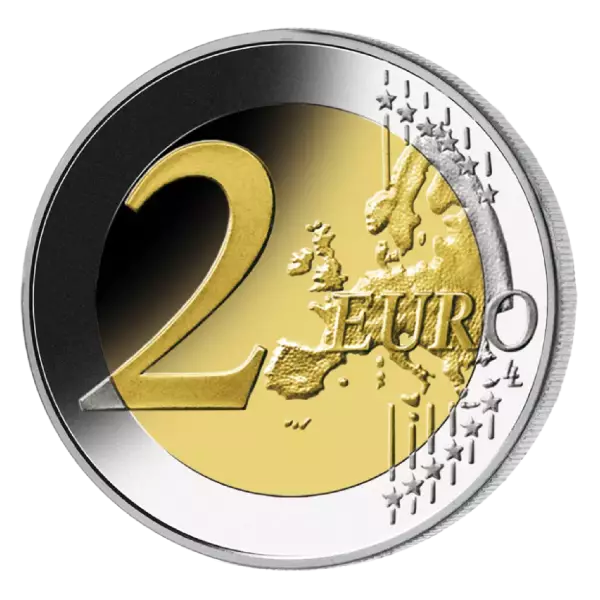

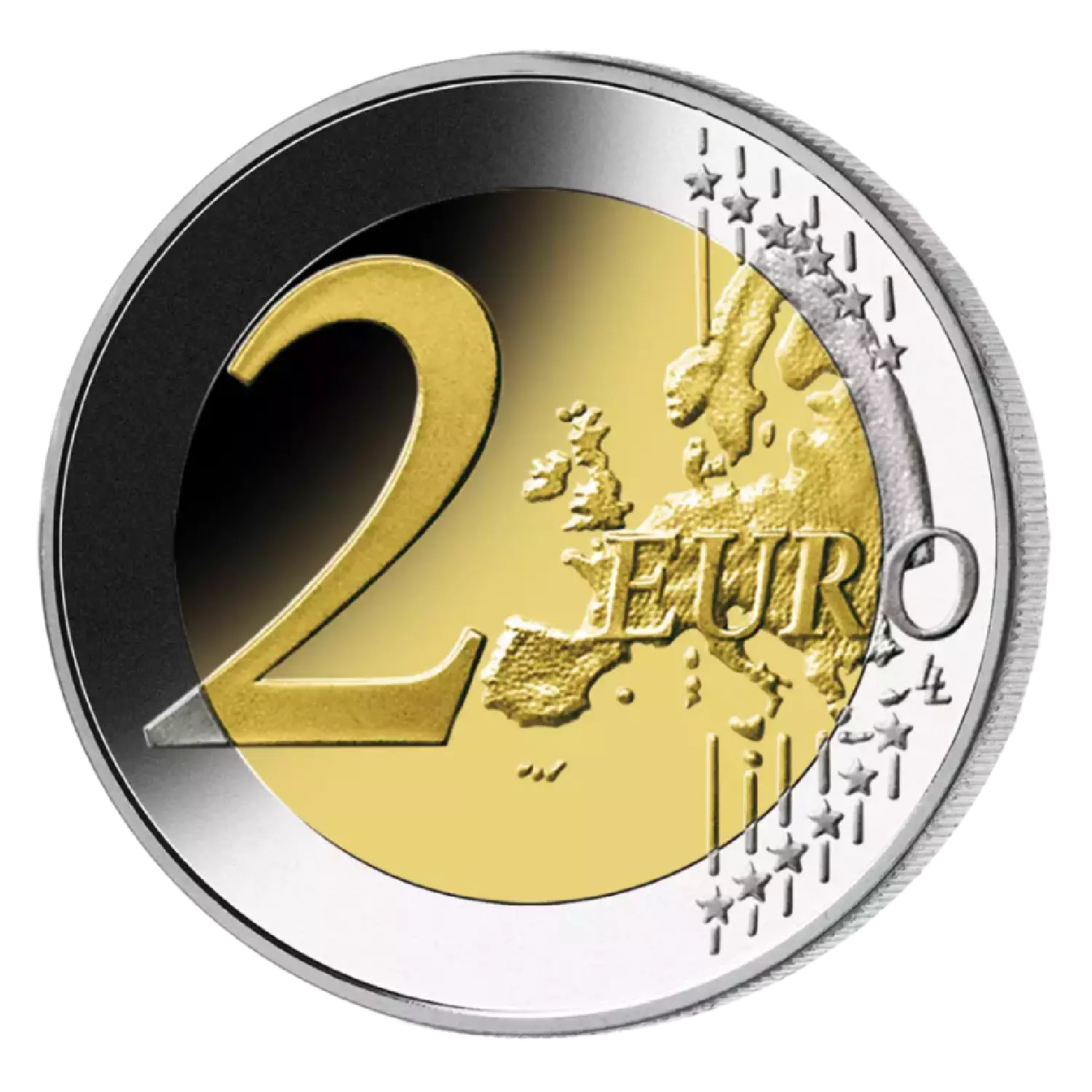
A joint 2 euro commemorative coin issued by Ireland in 2015 to commemorate the 30th anniversary of the European Union flag. The joint design was by Georgios Stamatopoulos (Greece). The Irish version has a mintage of 1,000,000. Bimetallic, diameter 25.75 mm, weight 8.5 g.
Obverse
The centre depicts a group of six people, joined in a circle and facing outwards, symbolising the 12 stars of the European flag. This symbolic composition represents the history, culture and ideals of Europe, which underlie the flag. The inscription "ÉIRE 1985-2015". On the outer ring - 12 EU stars.
Reverse
The reverse is the common side of the 2 euro coins of the second type, designed by Luc Luix. It depicts a map of Europe as a single continent without internal borders. On the left - a large denomination "2" and the inscription "EURO", on the right - a map. On the outer ring - 12 stars of the European Union. The band - with fine ribbing and national inscription.
Historical context
The European flag - 12 yellow stars on a blue background - is one of the most recognizable symbols of Europe. Officially adopted by the Council of Europe on 8 December 1955, and on 29 May 1986 - by the European Communities (the predecessor of the EU). The number 12 symbolizes not the number of member states, but the concepts of completeness, unity and perfection. The blue represents the sky, the yellow represents the star. The flag was designed by Arsène Heitz and Paul Lévy. Today, 27 EU countries are united under this flag. Ireland joined the European Communities on 1 January 1973, and the Economic and Monetary Union on 1 January 1999 (the euro was adopted on 1 January 2002). Ireland is one of the most active participants in European integration, known for its pro-European views. According to Eurobarometer surveys, the Irish are among the most supportive of EU membership.