
Shopping Cart
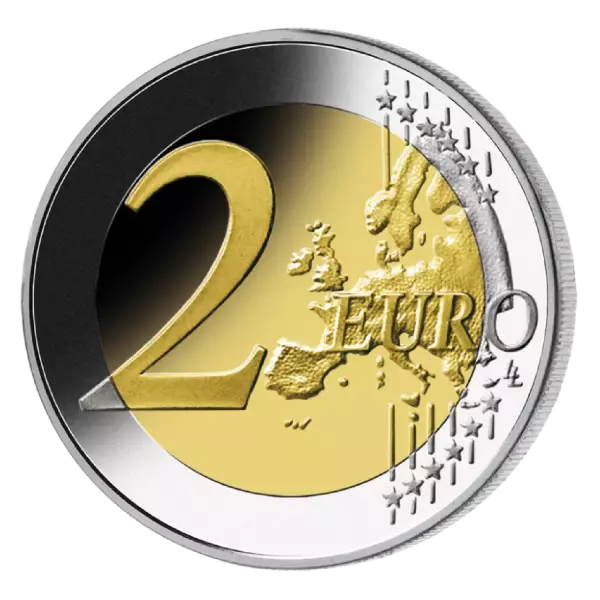

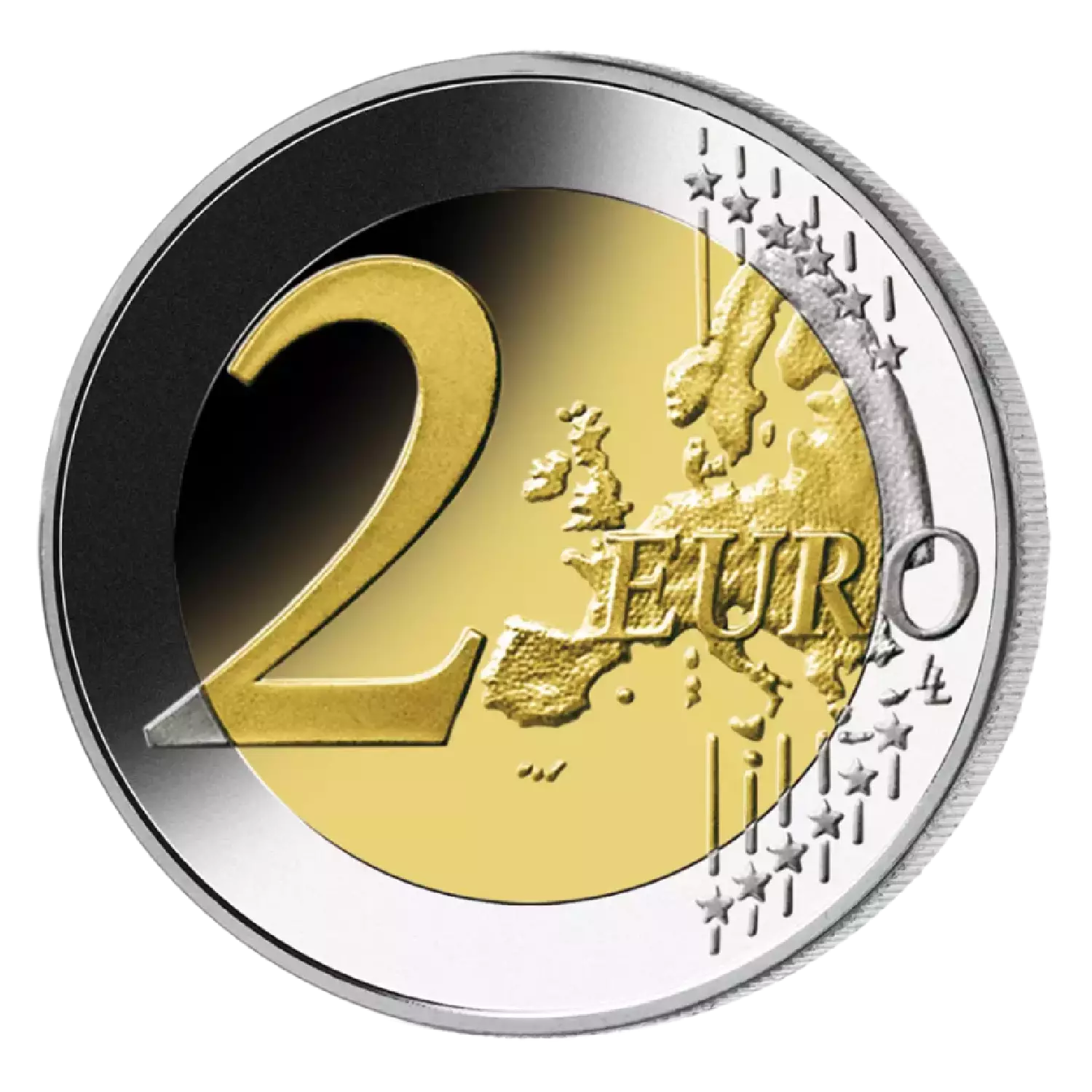
A 2 euro commemorative coin of the Italian Republic, issued in 2014 in a circulation of 6,500,000 copies. Dedicated to the 450th anniversary of the birth of Galileo Galilei. The author of the design is Claudia Momoni. Bimetallic, diameter 25.75 mm, weight 8.5 g. Minted at the IPZS in Rome.
Obverse
The center of the coin depicts a portrait of Galileo Galilei, based on a painting by Justus Sustermans (1636), which is kept in the Uffizi Gallery in Florence. Galileo is depicted in adulthood with a characteristic penetrating gaze. At the top, in an arc, is the inscription "GALILEO GALILEI". Below are the dates "1564-2014". On the left is the monogram "RI" (Repubblica Italiana), on the right is an image of Galileo's famous telescope, with which he made revolutionary astronomical discoveries, with the mint mark "R". In the lower right corner are the author's initials. On the outer ring are the 12 five-pointed stars of the European Union.
Reverse
The reverse is the common side of the 2 euro coins of the second type, designed by Luc Luix (Royal Belgian Mint). It depicts a map of Europe as a single continent without internal borders - a symbol of European unity. On the left is a large denomination "2" and the inscription "EURO", on the right is a map with six thin horizontal lines in the background. On the outer ring are the 12 stars of the European Union. The band is finely fluted and has the inscription "2 ★", repeated six times alternately upright and inverted.
Historical context
Galileo Galilei (1564-1642) was an Italian astronomer, physicist, mathematician, natural philosopher, and one of the founding fathers of modern science and the scientific method. He was born on February 15, 1564 in Pisa, where he graduated from the Faculty of Medicine. From 1589, he taught mathematics at the universities of Pisa and Padua. In 1609, he improved the design of the Dutch telescope and made revolutionary astronomical discoveries: the four largest satellites of Jupiter (1610), called Galilean; the phases of Venus; spots on the Sun; mountains and craters on the Moon; the rings of Saturn. Confirmed the heliocentric system of Copernicus by publishing "Dialogue on the Two Chief Systems of the World" (1632), for which in 1633 he was sentenced by the Inquisition to life under house arrest. He was forced to formally renounce his theories. Among other discoveries are the law of free fall of bodies, the pendulum principle, and the foundations of mechanics. He died on January 8, 1642 in Arcetra. He was rehabilitated by the Catholic Church in 1992 by Pope John Paul II.