
Shopping Cart
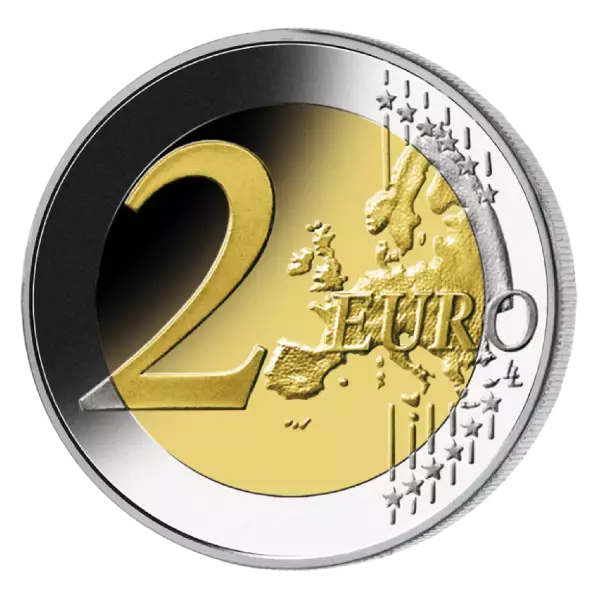

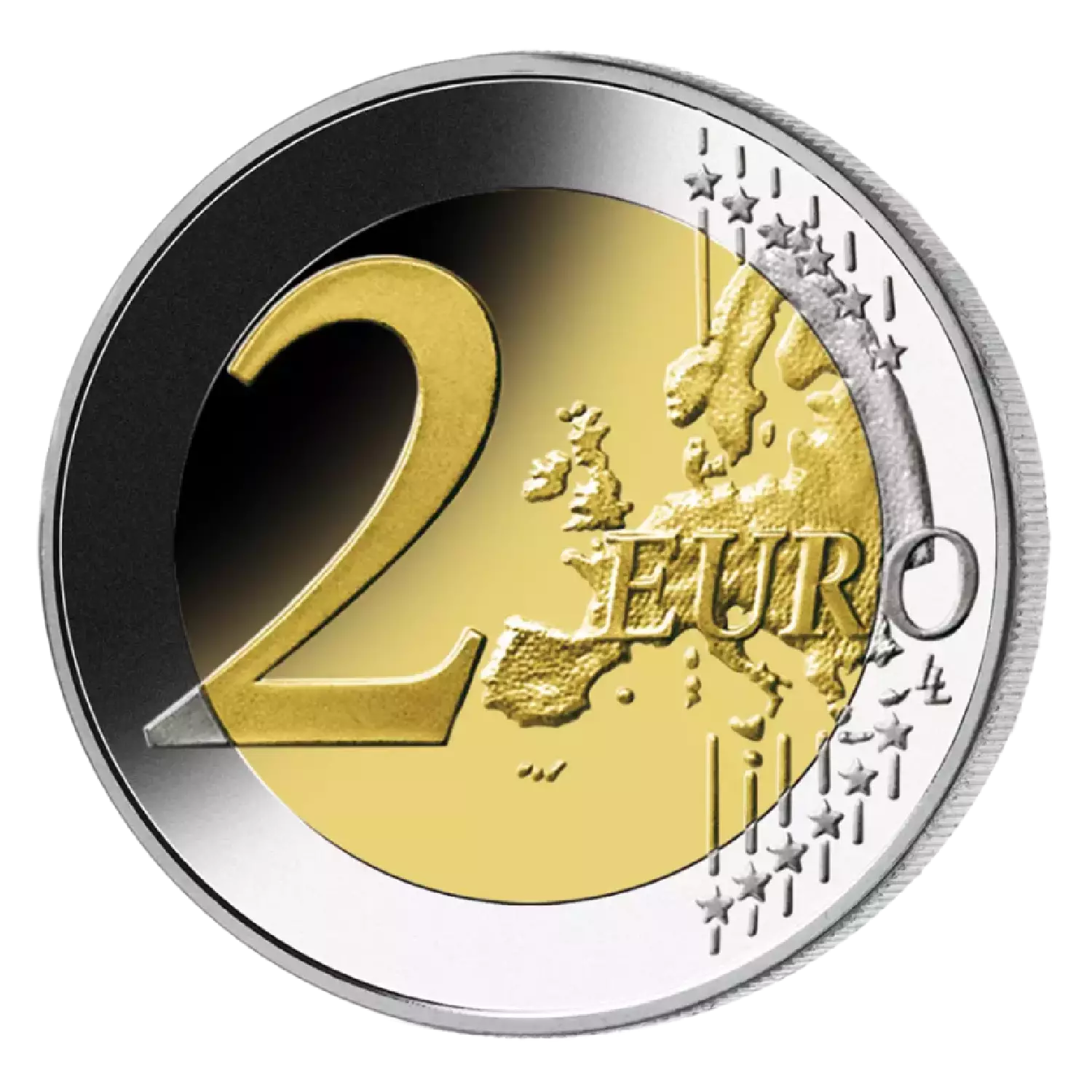
Commemorative coin of the Grand Duchy of Luxembourg, issued in 2015 in a circulation of 500,000 copies. Joint issue of 19 eurozone countries in honor of the 30th anniversary of the EU flag. Minted at the Royal Netherlands Mint. Bimetallic, diameter 25.75 mm, weight 8.5 g.
Obverse
The center of the coin depicts the flag of the European Union as a symbol uniting peoples and cultures. Twelve stars, which smoothly transform into stylized human figures, embrace each other - a symbol of the birth of a new Europe. At the top right, in a semicircle, is the name of the country "LËTZEBUERG" and the years "1985-2015". At the bottom right are the initials of the author (George Stamatopoulos). Includes a hidden relief with a portrait of Grand Duke Henri (a characteristic feature of all common euro issues of Luxembourg). On the outer ring are 12 five-pointed stars.
Reverse
The reverse is the common side of the 2 euro coins of the second type, designed by Luc Luix (Royal Belgian Mint). It depicts a map of Europe as a single continent without internal borders - a symbol of European unity. On the left - a large denomination "2" and the inscription "EURO", on the right - a map with six thin horizontal lines in the background. On the outer ring - 12 stars of the European Union. The band is finely ribbed and the inscription "2 ★", repeated six times alternately upright and inverted.
Historical context
The flag of Europe is the official flag of the European Union, consisting of 12 golden five-pointed stars on a blue background, arranged in a circle. It was developed and adopted by the Council of Europe on 8 December 1955 as a symbol of all of Europe. In 1985, it was adopted as its official symbol by the European Communities, the predecessor of the EU. The decision was made by the European Council at the summit in Milan on 28–29 June 1985 and entered into force on 21 April 1986. The twelve stars are not related to the number of member states, but symbolize perfection, completeness and unity. The blue color was chosen as a symbol of the sky, and the gold color as a symbol of wealth. The design was created by Arsène Heitz, a postal worker from Strasbourg. Luxembourg was one of the six founding members of the European Communities, signing the Treaty of Rome on 25 March 1957.