
Shopping Cart
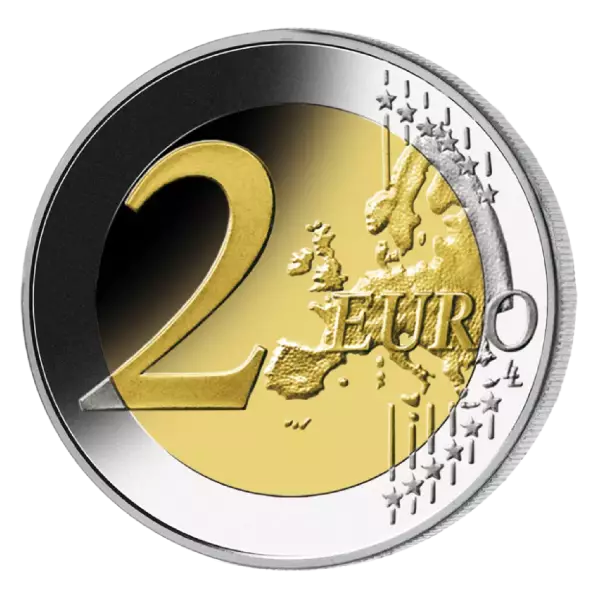

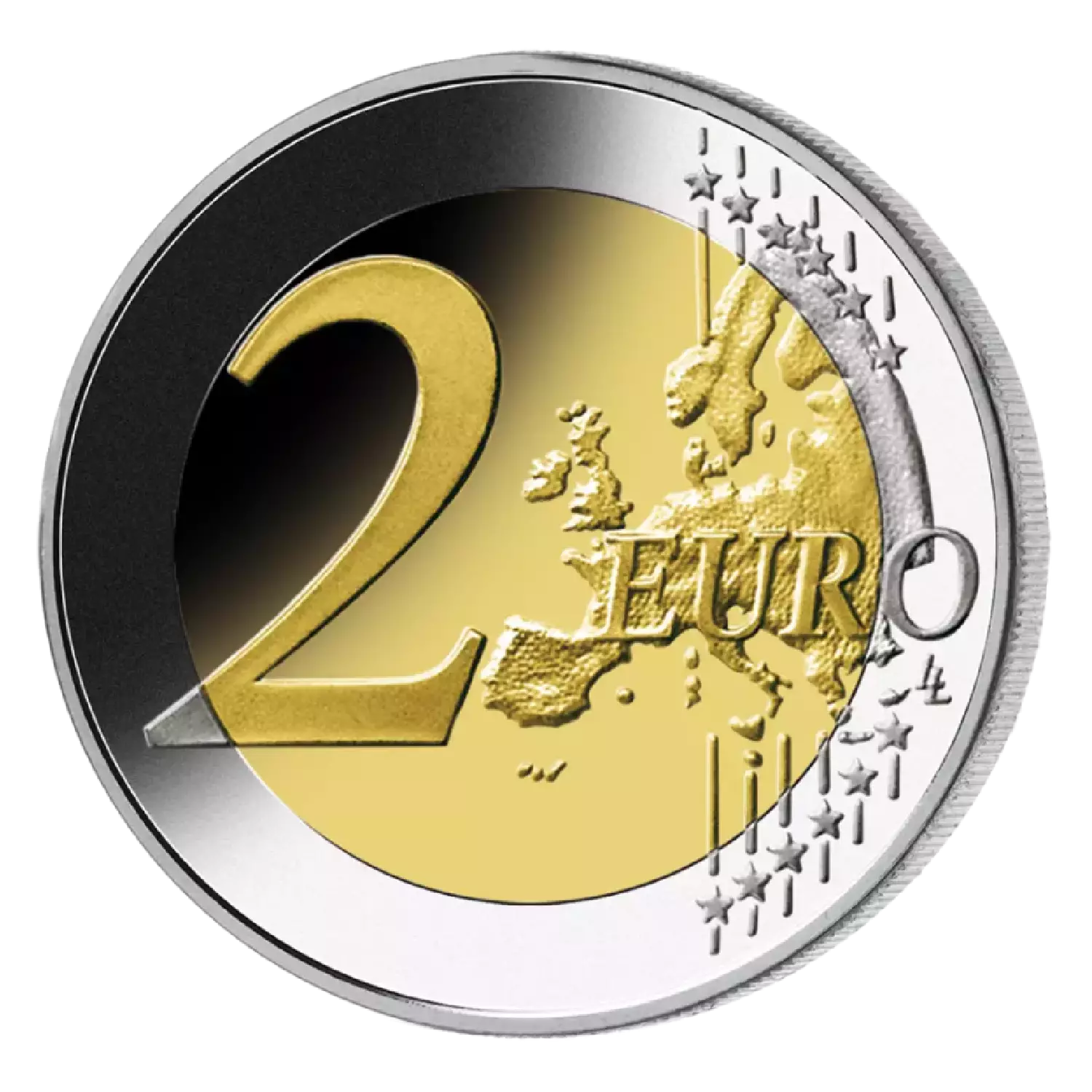
Commemorative coin of 2 euros of Germany, issued in 2009. Joint issue of 16 eurozone countries in honor of the 10th anniversary of EMU. Author of the joint design — George Stamatopoulos (Bank of Greece). Minted at five German mints. Total circulation of 30 million copies. Bimetallic, diameter 25.75 mm, weight 8.5 g.
Obverse
In the center of the coin is depicted a stylized human figure reaching out to the large euro symbol "€". On the right — the inscription "BUNDESREPUBLIK DEUTSCHLAND". Above — "WWU 1999-2009" (Wirtschafts- und Währungsunion — Economic and Monetary Union). Around the figure — the names of the 16 eurozone countries in lowercase letters. Below — the mint mark. On the outer ring are the 12 stars of the EU.
Reverse
The reverse is the common side of the 2 euro coins of the second type, designed by Luc Luix (Royal Belgian Mint). It depicts a map of Europe as a single continent without internal borders - a symbol of European unity. On the left is a large denomination "2" and the inscription "EURO", on the right is a map with six thin horizontal lines in the background. On the outer ring are the 12 stars of the European Union. The band is finely fluted and has the German inscription "EINIGKEIT UND RECHT UND FREIHEIT" (Unity and Law and Freedom - words from the German national anthem).
Historical context
The Economic and Monetary Union (EMU; German: Wirtschafts- und Währungsunion, WWU) is a key stage of European integration, completed on 1 January 1999 with the introduction of the common currency, the euro. Germany played a central role in the creation of the EMU: Chancellor Helmut Kohl was one of the main promoters. The European Central Bank (ECB) has its headquarters in Frankfurt am Main (since 1998). The Maastricht Treaty of 1992 laid the foundation for the EMU with three stages: I - capital liberalization; II - creation of the European Monetary Institute; III (since 1999) - introduction of the euro. The Deutsche Mark was replaced by the euro at a rate of 1 euro = 1.95583 DM. It was the second strongest currency in the world after the dollar. The Bundesbank (Germany's central bank) became a member of the Eurosystem. In 2009, there were 16 countries in the eurozone.