
Shopping Cart
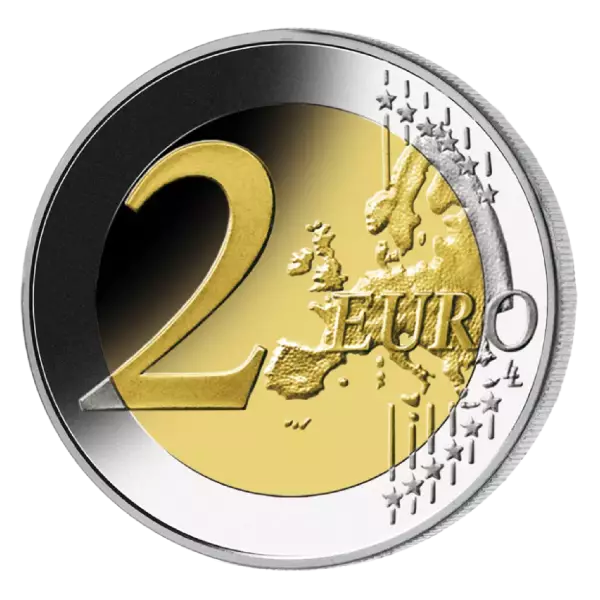

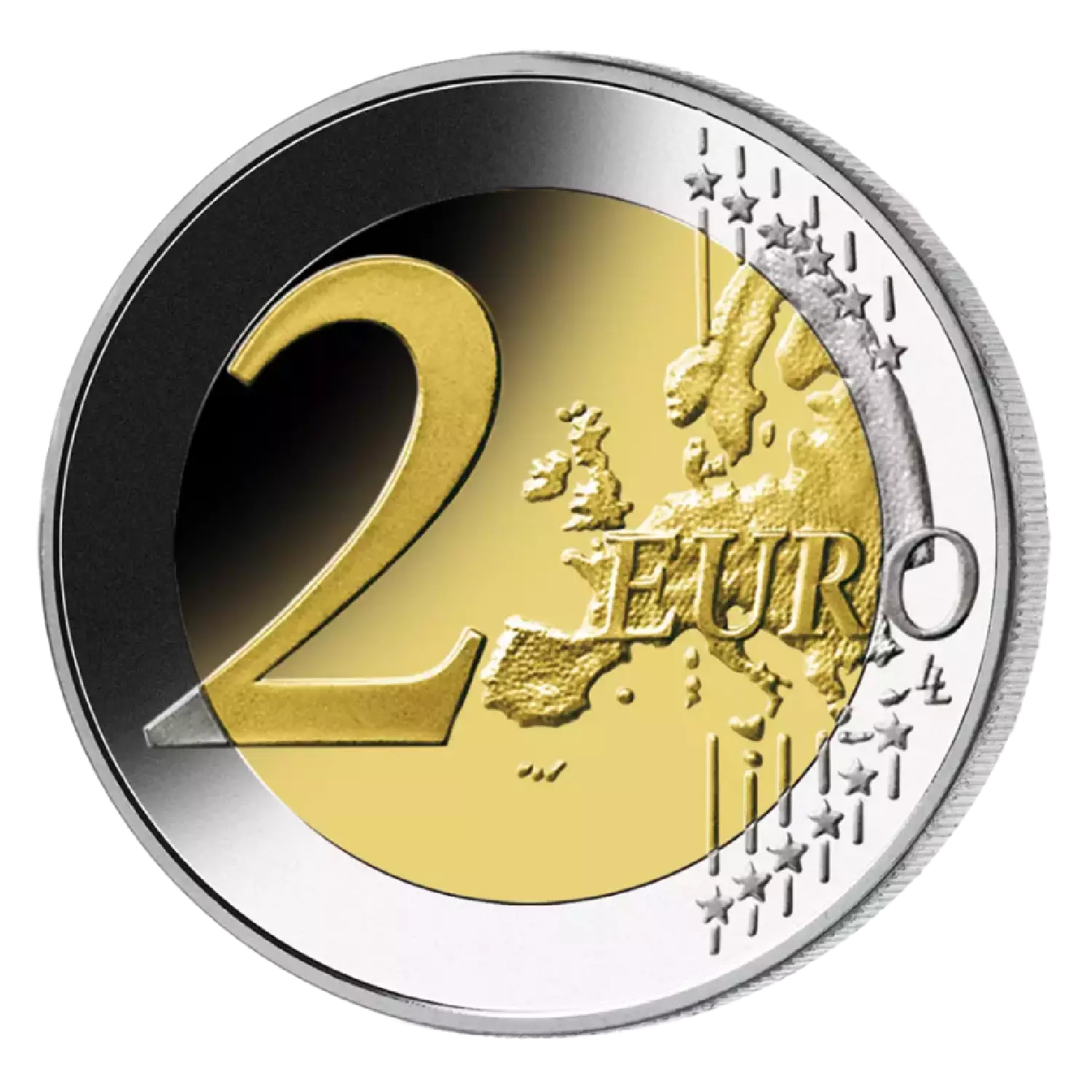
A 2 euro commemorative coin of the Republic of San Marino, issued in 2005 in a circulation of 130,000 copies. Dedicated to the World Year of Physics 2005. Minted in IPZS, Rome. Bimetallic, diameter 25.75 mm, weight 8.5 g.
Obverse
The center of the coin depicts a stylized composition - the forces of nature in the form of a human figure, symbolizing physics. Next to it is the formula "E=mc²" - the basis of Einstein's special theory of relativity. Above - "2005 ANNO MONDIALE DELLA FISICA", below - "San Marino". Mark "R". On the outer ring are the 12 five-pointed stars of the European Union.
Reverse
The reverse is the common side of the 2 euro coins of the first type, designed by Luc Luix (Royal Belgian Mint). It depicts a map of the enlarged European Union with stylized lines below the map. On the left is a large denomination "2" and the inscription "EURO". On the outer ring are the 12 five-pointed stars of the EU. The band is finely grooved and the inscription "2 ★" repeated 6 times.
Historical context
The World Year of Physics 2005 (or Einstein Year) is an international initiative proclaimed by the UN General Assembly by resolution 58/293 of June 10, 2004 in honor of the 100th anniversary of the so-called "Annus Mirabilis" of Albert Einstein (1879-1955). In 1905, Einstein, then a modest expert at the patent office in Bern (Switzerland), published four revolutionary articles in the "Annalen der Physik" that changed the physics of the 20th century: 1) on the photoelectric effect (this work brought him the Nobel Prize in 1921, laid the foundation for quantum mechanics); 2) on Brownian motion (confirmed the atomic theory); 3) on the special theory of relativity ("On the electrodynamics of moving bodies"); 4) the famous E=mc² (on the equivalence of mass and energy). All these works were published within one year - hence the term "Annus Mirabilis" (Miraculous Year). In 2005, scientific conferences, exhibitions, and educational programs promoting physics were held around the world.