
Shopping Cart
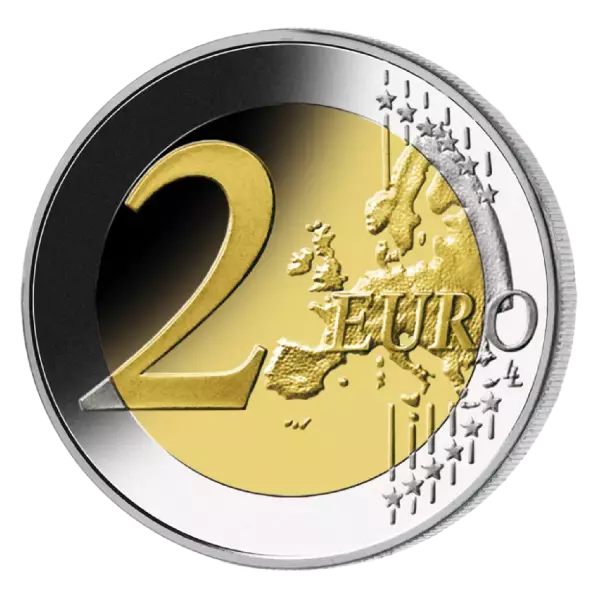


A 2 euro commemorative coin of the Vatican City State, issued on October 27, 2023, with a circulation of 68,000 copies. Dedicated to the 150th anniversary of the death of Alessandro Manzoni. The author of the design is Gabriella Titotto (G. Titotto). Bimetallic, diameter 25.75 mm, weight 8.5 g. Minted at the IPZS in Rome.
Obverse
The center of the coin depicts a detailed portrait of Alessandro Manzoni, which conveys the writer's characteristic features and pensive expression. Next to the portrait is a pen and the beginning of the manuscript of his masterpiece "I Promessi Sposi" ("The Betrothed"), emphasizing Manzoni's literary contribution. At the top, in a semicircle from left to right, is the inscription "CITTÀ DEL VATICANO" and the author's signature "G. TITOTTO". At the bottom is the handwritten inscription "Alessandro Manzoni" and the years "1873◦2023". On the left is the mint mark "R". On the outer ring are the 12 stars of the European Union.
Reverse
The reverse is the common side of the 2 euro coins of the second type, designed by Luc Luix. It depicts a map of Europe as a single continent without internal borders. On the left is a large denomination "2" and the inscription "EURO", on the right is a map. On the outer ring are the 12 stars of the EU. The rim is finely fluted and the inscription "2 ★", repeated six times alternately upright and inverted.
Historical context
Alessandro Manzoni (1785-1873) was an outstanding Italian writer, poet and playwright of the Romantic era, one of the fathers of the modern literary Italian language. He was born on March 7, 1785 in Milan. His main work, the historical novel "The Betrothed" (I Promessi Sposi), published in 1827 and revised in 1840-1842, is considered a masterpiece of Italian literature and a key work for the formation of a unified Italian language. The events of the novel take place in Lombardy in the 17th century during the plague epidemic. Manzoni was an ardent Catholic, a senator of the Kingdom of Italy. He died on May 22, 1873 in Milan. Upon his death, Giuseppe Verdi wrote the famous Requiem (1874), dedicated to the writer's memory.