
Shopping Cart
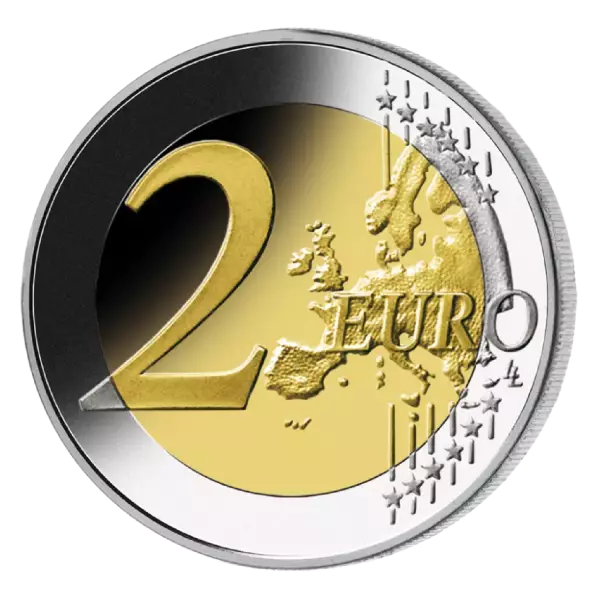


A 2 euro commemorative coin of the Vatican City State, issued in 2024 with a circulation of about 80,000 copies. Dedicated to the 150th anniversary of the birth of Guglielmo Marconi. The author of the design is Loredana Pancotto (L. Pancotto), the engraver is Annalisa Masini (A.M. INC). Bimetallic, diameter 25.75 mm, weight 8.5 g. Minted at IPZS in Rome.
Overse
The design is inspired by a historical photograph taken on February 12, 1931, the day of the official inauguration of Vatican Radio. In the center of the coin is a portrait of Guglielmo Marconi, on the right is a portrait of Pope Pius XI, on the left is a portrait of Cardinal Secretary of State Eugenio Pacelli, the future Pope Pius XII. Three portraits are placed above a stylized radio wave, a symbol of Marconi's invention. At the top right, in a semicircle, is the inscription "GUGLIELMO MARCONI", below it are the years "1874" and "2024". At the bottom are the inscription "CITTÀ DEL VATICANO" and the name of the author "L. PANCOTTO", as well as the initials of the engraver "A.M. INC". At the left is the mint mark "R". On the outer ring are the 12 stars of the EU.
Reverse
The reverse is the common side of the 2 euro coins of the second type, designed by Luc Luix. It depicts a map of Europe as a single continent without internal borders. On the left is a large denomination "2" and the inscription "EURO", on the right is a map. On the outer ring are the 12 stars of the EU. The band is finely grooved and bears the inscription "2 ★", repeated six times alternately upright and inverted.
Historical context
Guglielmo Marconi (1874-1937) was an outstanding Italian engineer and inventor, one of the pioneers of radio communication and wireless telegraphy. He was born on April 25, 1874 in Bologna. In 1895, he conducted the first successful experiments on the transmission of radio signals over a distance, and in 1901, he made the first transatlantic radio connection between Great Britain and Newfoundland. In 1909, he received the Nobel Prize in Physics (together with Karl Ferdinand Braun) for his contribution to the development of wireless telegraphy. On 12 February 1931, Marconi personally launched the Vatican radio station (Radio Vaticana), which he had built at the request of Pope Pius XI. During the first broadcast, Marconi announced: "I have the highest honor to announce that in a few minutes the Holy Father Pius XI will inaugurate the Vatican City radio station." He died on 20 July 1937 in Rome.