
Shopping Cart
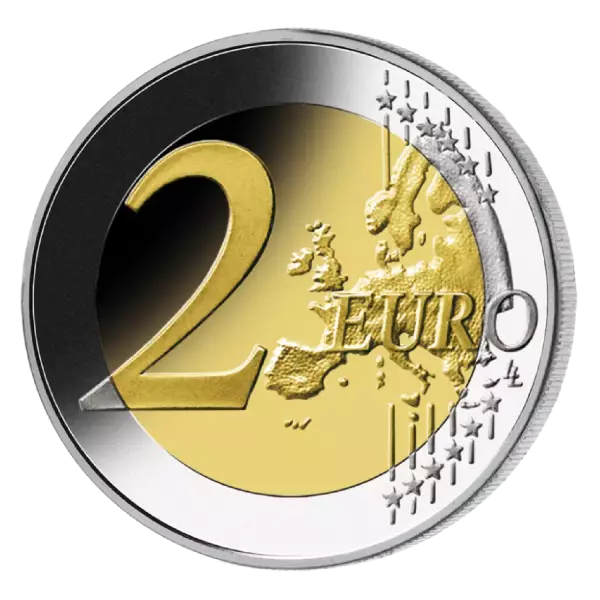

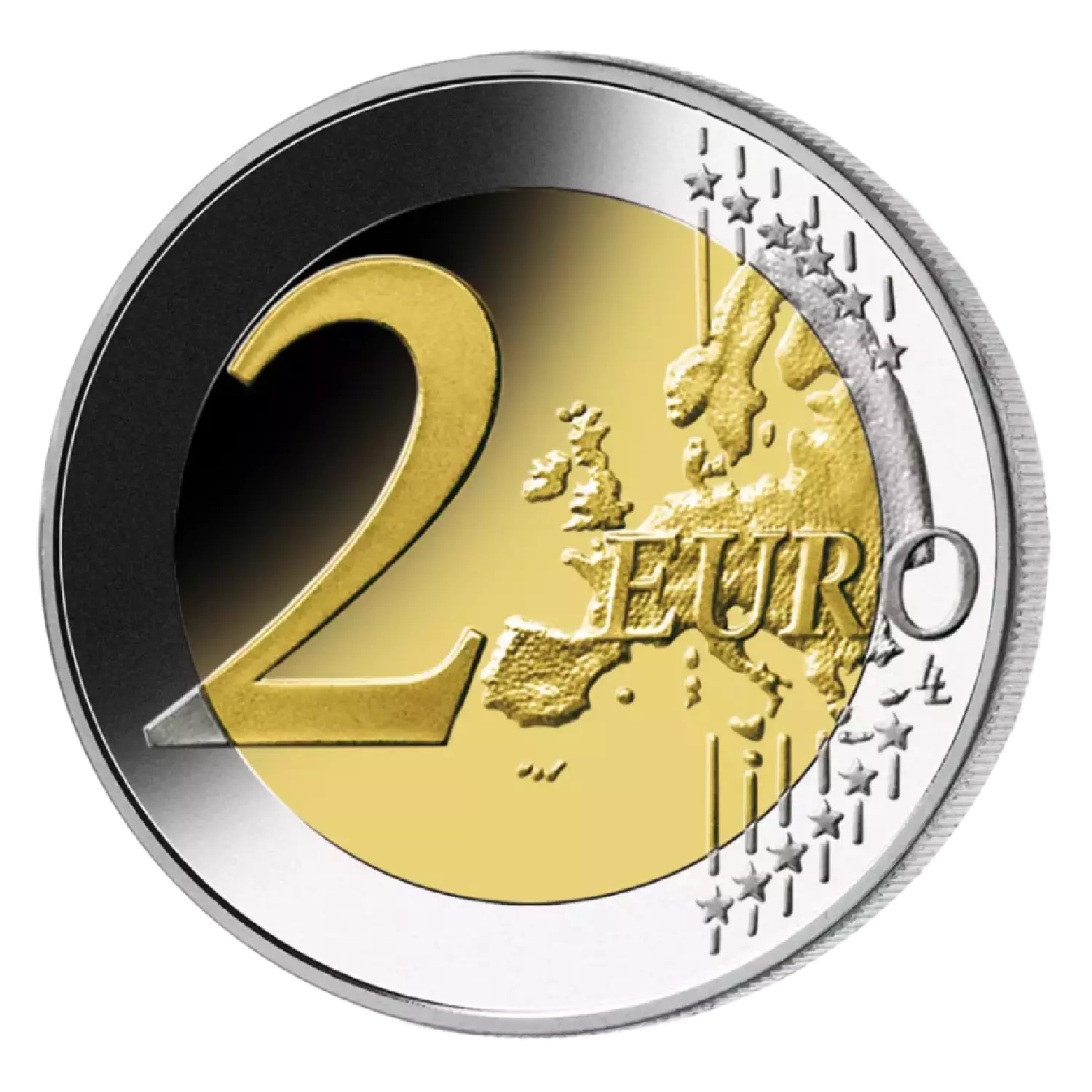
2 euro commemorative coin of the Italian Republic, issued in 2015 with a circulation of 3,515,000 copies. Dedicated to the 750th anniversary of the birth of Dante Alighieri. The author of the design is Silvia Petrassi. Bimetallic, diameter 25.75 mm, weight 8.5 g. Minted at IPZS in Rome.
Obverse
The center of the coin depicts Dante Alighieri with the Divine Comedy in his hands. The image is inspired by the portrait of Dante from Raphael Santi's fresco "The Disputation on the Holy Trinity" (La Disputa) in the Raphael Rooms in the Apostolic Palace. In the background is the silhouette of Mount Purgatory, which the poet described in the second part of the Divine Comedy. At the top of the arc is the inscription "Dante Alighieri", below it is the monogram "RI" (Repubblica Italiana). On the right is the mint mark "R" (Rome). Below are the initials of the author and the date "1265-2015". On the outer ring are the 12 stars of the EU.
Reverse
The reverse is the common side of the 2 euro coins of the second type, designed by Luc Luix (Royal Belgian Mint). It depicts a map of Europe as a single continent without internal borders - a symbol of European unity. On the left is a large denomination "2" and the inscription "EURO", on the right is a map with six thin horizontal lines in the background. On the outer ring are the 12 stars of the European Union. The band is finely fluted and the inscription "2 ★", repeated six times alternately upright and inverted.
Historical context
Dante Alighieri (c. 1265-1321) is a great Italian poet, thinker, philosopher, theologian and politician, one of the founders of the literary Italian language and the father of European literature of the modern era. He was born in Florence around May-June 1265 into a noble but poor family. He studied at the universities of Bologna and, possibly, Paris. His main muse was Beatrice Portinari, to whom he dedicated "The New Life" (La Vita Nuova). He held positions in Florence, was a prior in 1300. In 1302, due to political intrigues, he was sentenced to death by exile from Florence, where he was never able to return. He hid in various cities in Italy. He died in Ravenna on the night of September 13-14, 1321. His magnum opus is The Divine Comedy (La Divina Commedia, c. 1307-1321), a poem describing a journey through Hell, Purgatory, and Paradise. Together with Petrarch and Boccaccio, he formed the Trecento, the golden age of Italian culture.